Black Bike Week 2026

A conversation with Randy “Detroit” Hayward (@detroit_antique_motorcycles) the architect of restoration, and how he is preserving black motorcycle history.

To Google him is to find a man obsessed with vintage rides, where the motorcycles were visceral, the mechanics were exposed, and every mile was earned. But while the world focuses on the machines in his garage, Detroit is increasingly focused on a different kind of restoration: the preservation of black motorcycle history.
Sitting down for an expansive conversation, Detroit speaks with the weight of a man who has realized that in a world of digital noise, truth is the final frontier. For him, Black Bike Week isn't just a destination on a map or a date on a calendar. It is a space of radical affirmation. It is where the "double consciousness" of the Black rider, the internal tension between being a celebrant of the road and a target of the gaze, finally finds a moment of rest.

Detroit’s entry into the heart of Black Bike Week, specifically the historic strip near Bethune-Cookman University, wasn't a calculated move. It was an accident. A few years back, he was riding through Daytona. He made a turn off International Boulevard, away from the neon commercialism of the mainstream rally, and found himself in a sea of chrome and community.
"I rolled through by mistake," Detroit recalls. "I saw these bikes and all these Black folk and I was like, 'What is going on?'" He began to research the space as a historian, peeling back the layers of a tradition that had been thriving in the shadows of the mainstream for over half a century.
When Harley-Davidson eventually asked him to bring his antique show to the space, Detroit accepted with a caveat: he would do it his way. He wasn't there to plant a corporate flag; he was there to ensure the culture wasn't for sale, even if it was willing to partner.

To understand Black Bike Week is to understand the difference between being a "secret" and being "ignored." Detroit notes that while Daytona Bike Week is a global phenomenon, you could put a hundred bikers in a room and perhaps only one would have heard of the gathering at Bethune-Cookman.
"Anybody that has to be affirmed means someone else was already affirmed," Detroit says. "And it means the group now being affirmed was marginalized or disregarded." Black Bike Week, which has existed since 1971, is the community’s answer to that disregard. It is an intimacy that looks like separation to the outsider, but feels like a family reunion to the participant.
Detroit navigates this space with a deep awareness of how the "other" is perceived. He talks about the heavy police presence and the lingering stereotypes that still haunt Black gatherings. Yet, when he rides in, he sees something else entirely. He sees a tapestry of motorcycle clubs, families, and builders who have been the architects of the culture's style for decades without ever receiving the credit.

When I first met Detroit at the Sons of Speed race he highlighted his love for the architects of this culture by handing me a sticker of four black motorcycle legends. (now proudly displayed on my motorcycle)
Hal “Demon” Wade was a champion from 1913 to 1922 in the Black racing circuit. (At the time all sports were segregated.)
Ben Hardy, the builder commissioned to build two iconic bikes for "Easy Rider" the Captain America chopper and the Billy Bike.
Bessie Stringfield, also known as the "Motorcycle Queen of Miami" was the first African-American woman to ride across the United States solo.
William Johnson, one of the first Black Harley-Davidson dealership owners and famous hill climber.

But the influence doesn't stop in the past. It is alive in the "Big Wheel" bikes, the 21-inch front ends, and the sound systems that are now standard factory options from major manufacturers. These trends didn't start in a boardroom in Milwaukee; they started in the urban centers. "That 21 on the front was an exaggeration," Detroit notes. "It came out of the Black chopper builders in the West Coast. Now you go to the dealership and it's right there. The culture gets drawn into the majority, and then people forget where it came from."

Detroit’s own show, Detroit’s Antique Motorcycle Show (aka The D.A.M. Show) is his way of forcing a conversation. In fact it was at Bethune-Cookman that he added a second “M” to the D.A.M. show, represening modern bikes, creating a bridge from the past to the present. At the show he intentionally strips away the signs and name tags from the bikes. He believes that if you want to know about a machine, you should have to speak to the human who built it.
"If the owner is Black, you gotta go talk to him, if the owner is White, you gotta go talk to him, if the owner is Latino, you gotta go talk to him," Detroit explains. "This may be the first time you’re talking to a Latino brother about his Vicla instead of just seeing it in a magazine." In this way, the motorcycle becomes a tool for dismantling "isms." It is a mechanical icebreaker that forces people out of their like-minded circles.
The "M" in the show's name represents the bridge. While Detroit’s heart belongs to the antiques, he realized that bringing only 1920’s iron into Black Bike Week felt a bit like an invasion. He began inviting modern builders like Gears Of Truth, owner of theMedusa bike, whose vibrant, contemporary bikes celebrate the "Coney Island" style of the 60s and 70s. By placing an 80-year-old bike next to a modern custom, Detroit illustrates a lineage.

Detroit’s perspective wasn't formed only in a library; it was forged on the streets of Detroit. He grew up in the mid-60s in Delray, a neighborhood where kids built their own versions of "hot rods" using 2x4s and stolen grocery cart wheels for bearings. He watched the Miles family on Terry Street, Black men who spent their weekends testing and tuning the superbikes of the era, Kawasaki 900s and Honda 750s.
"I wanted to be them," Detroit remembers. "I was glad to be able to cut their grass and shovel their snow just to be near those bikes." He was a kid who wore ‘Apple hats’ and jewelry, dreaming of the day he’d have his own machine. That upbringing gave him a lens that many lack, a realization that motorcycle culture has always been a diverse, gritty, and deeply creative tapestry.
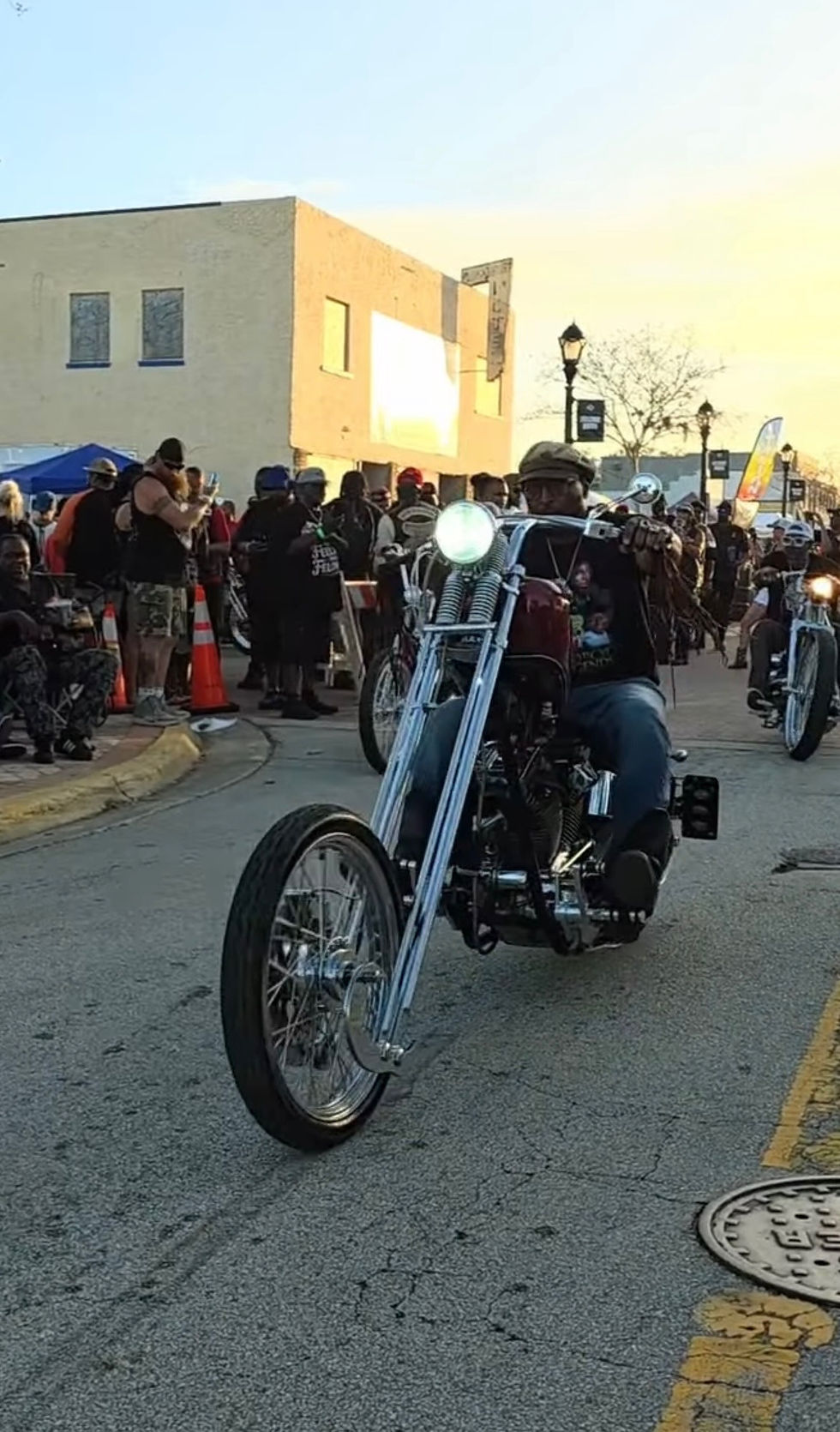
As the sun sets over the campus of Bethune-Cookman, the atmosphere of Black Bike Week shifts into something Detroit describes as a "comfort." It’s the sound of the music, the smell of the honey-spice wings from the Bethune Cafe, and the sight of thousands of riders who have found a home.
Detroit remains humble about his role in this ecosystem. "If you treat Black Bike Week as a road of bricks, I’m a pebble," he says. "I have yet to establish myself as a brick." But pebbles are what fill the gaps between the bricks; they are the things that keep the road from shifting.
By bringing his ‘Traveling Black History Museum’ exhibit to these spaces, Detroit is ensuring that the next generation of riders understands they aren't just participants in a hobby, they are heirs to a legacy. He is teaching those who are willing to learn. Because at the end of the day, Detroit knows that the road doesn't care about the color of the rider, but the history of the road belongs to everyone who had the courage to ride it. And Detroit is making sure that for once, the whole story is told.