Michelle Lamphere, the KLR, and the Long Way Down
Updated: Apr 27
When the road delivers you both the problem and the solution.
I got an intro to Michelle Lamphere from my story with Zee, who suggested she might have stories to tell. I figured we would talk about her years of international riding, her books, her work with women riders. Michelle is the International Vice-President of WIMA & National President of WIMA USA.
Instead, I got hit with a story that starts on the Trans-Labrador Highway with a broken leg, a satellite phone drifting away on a KLR650, and an entire province of strangers showing up as if the universe had them on speed dial.
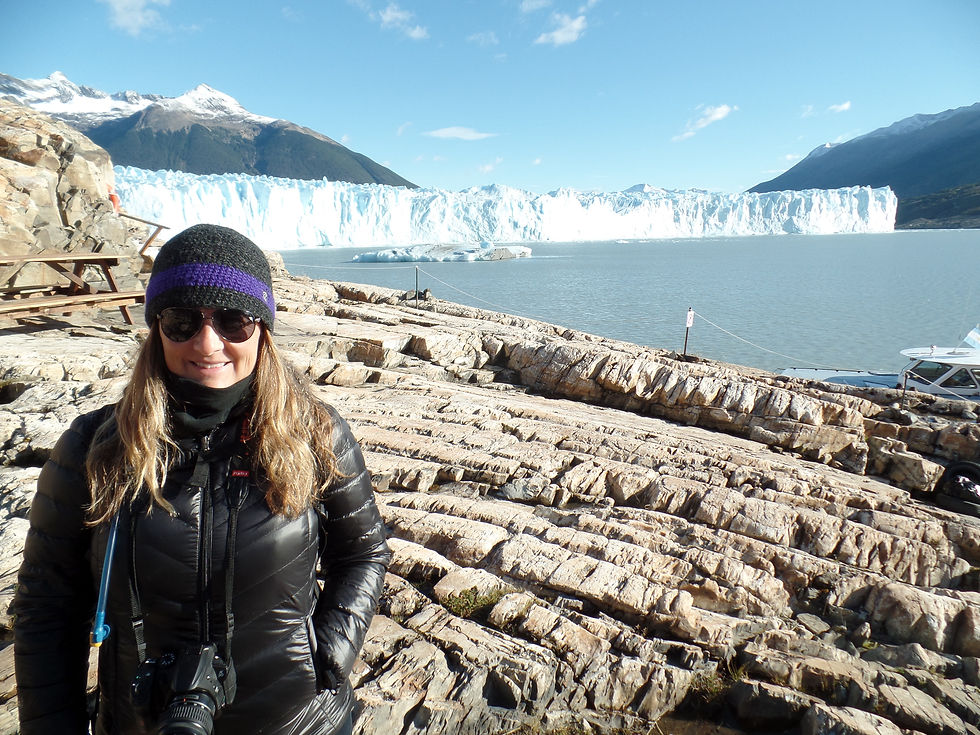
Turns out some riders get graced with some serious luck on the road.
Michelle grew up in Sturgis, which automatically gives her a rider’s pedigree. But her path wasn’t hot rods and Harleys. She learned to ride a dirt bike, bought her first real bike, a Harley, at 30. Then met a British guy travelling on a dual-sport, and she was on a KLR 650 before she knew it.
The KLR 650 that would bring her to the Trans-Labrador Highway, littered with fresh gravel, unstable roadbed, and nothing packed in. “It was 250 miles with no towns, no fuel, no anything,” she said. “You had to carry your own gas, or you weren’t making it.”
Unfortunately, deep gravel started doing what deep gravel does, sending the KLR swimming. Michelle crossed a ridge of freshly graded loose rock without problem the first few times. She is not an amateur rider, mind you, but on a final pass, the bike went down on its left side, pinning her leg under the peg.

A spiral fracture in her tibia and fibula, a hundred miles from civilization, and her boyfriend had already crested the next hill, disappearing in a cloud of dust.
Michelle sat up, pulled off her helmet, took inventory of the pain, then promptly spotted the satellite phone strapped to the bike that had just slid away from her.
“I remember thinking, ‘Okay… how am I getting to that phone?’”
Then, in the middle of absolute nowhere, a voice behind her:
“Ma’am, are you okay?”
But the universe was not done handing her a lucky break…
Within 15 minutes:
An RCMP officer (Royal Canadian Mounted Police)
A local EMT in a white cargo van
Two Canadian Fisheries & Wildlife officers
The husband of an ER nurse
And finally, her boyfriend looping back
All arrived independently, one dust cloud at a time, like some cosmic relay team.
The EMT initially insisted her leg wasn’t broken “You’d be in more pain,” he said. When the Fisheries & Wildlife guys arrived, they built a makeshift windbreak to stop her from freezing in the wind. One of them called his wife, an ER nurse, directly for guidance until the ambulance arrived hours later.
“I never imagined I’d get that lucky,” Michelle told me. “It was like the universe conspired to take care of me.”

The EMT in the van had initially offered to haul and store the bike for her in the nearest town but the moto community in NewFoundland really stepped up from there. They worked together to arrange a 1000-mile transport for the bike post-recovery, a stored place in Newfoundland and a place for her boyfriend and her to stay, free of charge for up to 3 months while she recovered. She reiterated a few times during our conversation, “Newfoundlanders are AMAZING!”
When I asked what she’d do differently, Michelle didn’t miss a beat.
Listen to your body - They’d been pushing hard because her boyfriend had a visa expiration date and they were trying to make miles. “I should’ve taken a day off,” she said. “My reactions weren’t sharp. I was tired. I knew it. And I ignored it.”
Skills fade, refresh them - Michelle had gravel experience, but “You can’t rest on what you did two years ago. Skills are perishable. You have to practice.”
Keep your critical gear on you - That satellite phone strapped to the bike? Yeah. Lesson learned.
After the ordeal, Michelle finished her ride to the bottom of South America. She crossed 20 countries. Returned to several. Built friendships with riders everywhere. “Motorcycles bring the best people into my life,” she said. “Everything I do now, my books, the podcast, the Women’s International Motorcycle Association, it all comes back to that community.”
As I interviewed Michelle, I realised I did not know enough about the Women’s International Motorcycle Association “WIMA is a network,” she said. “If a woman wants to ride in another country, we have people on the ground. Locals. Friends. Safety. Guidance. Community.”
The very thing that saved her on a gravel road in Labrador is now what she builds for others, every day.
The Takeaways
For New Rider - Your body is a gauge, trust it. Fatigue is real, and it hides in the moment right before things go wrong. Take breaks. Stretch. Drink water.
For Experienced Riders - You’re not immune to skill fade. Practice in the conditions you avoid. Refresh the fundamentals.
For All of Us - Community is your real safety net. Whether you’re 100 miles from anything or down the block in your hometown, the people who ride are the people who show up.
Michelle’s story isn’t about breaking her leg. It’s about who arrives when everything breaks.


