1977 Suzuki GS750 Review

Updated: Jun 11
The Bike That Redefined Japanese Engineering
Is the 1977 Suzuki GS750 a good vintage bike? Yes. As Suzuki’s first four-stroke, four-cylinder motorcycle, the GS750 is renowned for its roller-bearing crankshaft, exceptional frame stiffness, and 72-horsepower DOHC engine. It corrected the handling flaws of its competitors (like the Honda CB750 and Kawasaki Z1), making it one of the most reliable and best-handling "Universal Japanese Motorcycles" (UJM) of the 1970s.

By the time I was old enough to ride, the 1977 Suzuki GS750 was already a "vintage" machine—a relic of cooling fins and heavy steel that predated my license by a decade. In the mid-90s, these were the bikes you found under dusty tarps or in local classifieds for a few hundred bucks. They weren’t icons yet; they were just old Suzukis.
But for those of us who grew up on used Japanese steel, the GS750 eventually revealed itself as something much more than a budget-friendly starter. It was the moment Suzuki finally moved past their two-stroke "Water Buffalo" era and decided to build a four-cylinder that would outlast the rider.
In the late '70s, "Superbike" frames were notorious for flexing under pressure—the dreaded high-speed wobble. Suzuki countered this by building a chassis that was uncharacteristically stiff for the time.
Even now, taking a sweeper on a forty-year-old GS, you don't feel that unsettling "hinge-in-the-middle" sensation common on early Kawasakis or Hondas. It tracks true. It goes where you point it. At 500-plus pounds, it has a gravity to it that modern bikes have engineered away, but once moving, that weight translates into deliberate stability.
Riding a used GS750 is a lesson in what "over-engineered" really means. Suzuki utilized a roller-bearing crankshaft in these early GS models. This design choice turned the bottom end of the motor into something nearly indestructible, capable of handling significantly more power than the stock 72 hp.

Even after decades of questionable maintenance, these engines pull with a linear, predictable torque. It doesn't have the sudden "hit" of a modern sportbike; instead, it has a relentless, locomotive-like quality that makes highway merging a non-event.
Maintenance is straightforward, which is why so many of these are still on the road. Unlike modern machines that require specialized diagnostic tools, the GS750 is a "mechanical" experience.
Valve Adjustments: Accessible double-overhead cams.
Ignition: Standard points system (though many riders upgrade to electronic ignition).

Ergonomics: A classic UJM "bench" seat that allows for two-up riding and long-distance comfort (comfort is being used loosely here)

1977 Suzuki GS750 Quick Specs
Feature
Specification
Engine Type
748cc, 4-cylinder, DOHC, 8-Valve
Power Output
72 HP @ 8,500 RPM
Top Speed
Approx. 120 MPH
Curb Weight
507 lbs (Dry)
Braking
Single disc front / Single disc rear
The Verdict: A Rider’s Bike
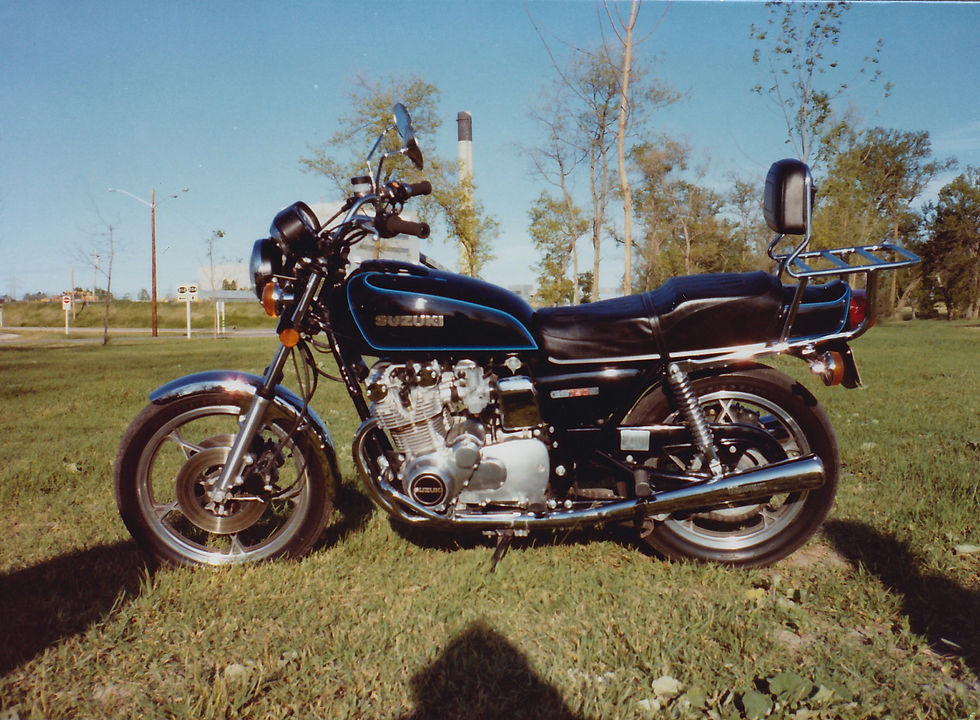
The 1977 Suzuki GS750 isn't the bike you buy to win a drag race or turn heads at a chrome-filled bike night. You buy it because you appreciate the era when Japan decided to prove they could build the best-engineered motorcycle in the world.
It’s heavy, it’s honest, and if you treat it with even a modicum of respect, it will probably outlive you. It is the ultimate testament to the idea that some things were simply built to last.
Looking for the GS750 community? Find every active forum HERE


